
When we think about financial planning, it’s often framed around the individual or the couple – their income, assets and retirement goals.
But for those in the “sandwich generation”, simultaneously supporting ageing parents and adult children, life rarely follows that pattern.
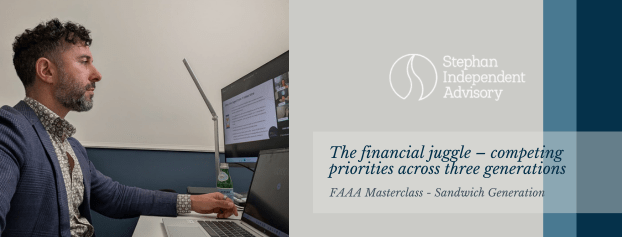
I recently presented a Financial Advice Association Australia (FAAA) Masterclass – The Financial Juggle: Competing Priorities Across Three Generations – exploring how financial decisions are increasingly made not in isolation, but within a system of competing needs across parents, children and your own future.
My focus was on the strategies that help you navigate these pressures – and ultimately achieve better outcomes across the entire family system.
The reality behind the sandwich generation
Traditional financial models assume that we move through life in a predictable pattern – borrowing when young, building wealth during our working years, then drawing on it in retirement.
Instead, the peak accumulation years are often when financial pressure is at its highest.
Support flows in both directions: upstream to parents navigating health, care and longevity; and downstream to children facing housing affordability, education costs and delayed independence.
What emerges is not a linear path, but a balancing act.
And for many, the challenge isn’t a lack of resources – it’s the difficulty of making clear, confident decisions when everything is connected.
When life gets complicated
One of the most common patterns we see is clients who, on paper, are in a strong position.
They’ve built successful careers, accumulated meaningful assets, and are approaching retirement with options.
But then life intervenes.
A parent’s health declines. Time and energy are redirected. Adult children need support for longer than expected. Roles within the family begin to shift.
Individually, each of these pressures is manageable, but together, they create complexity and decision fatigue.
Key questions to achieve clarity
Rather than treating each issue in isolation, we need to understand how financial and non-financial pressures interact across the family system.
In the session, I shared a series of client questions designed to bring this into focus:
- Where are you already providing support – financially, practically, or emotionally?
- What role might you need to play if circumstances change?
- What do you feel responsible for when it comes to your children?
- How would you prioritise between competing demands if you had to?
- And what assumptions are you making about future support or inheritance?
These questions focus on values, expectations and trade-offs.
Because without clarity here, it’s easy to drift into reactive decisions – often driven by emotion rather than intent.
A framework for navigating priorities
For the sandwich generation, a clear hierarchy for making decisions can help reduce both financial strain and emotional overwhelm.
First, stabilise parents. Ensuring dignity, care and stability upstream is often the most immediate pressure point – whether that support is financial, practical or simply time and coordination.
Second, protect yourself. This is the critical anchor. Maintaining your own health, capacity and long-term financial independence is what allows you to continue assisting others without the system becoming fragile.
Third, strengthen your own position. Reducing debt, building super and securing your retirement trajectory creates resilience – giving you more flexibility in how and when you provide help.
Fourth, support children. Assisting with housing, education or life milestones can be incredibly valuable, but it needs to be done within your capacity – not at the expense of long-term security.
And finally, equalise over time. Fairness across generations doesn’t need to happen in real time. Estate planning can be used to balance outcomes later, reducing pressure and guilt in the present.
From structure to strategy
At Stephan Independent Advisory, this is where structure becomes action. Once priorities are clear, we help you implement a set of coordinated strategies designed to support the entire family system.
This often includes:
Life and Career Rediscovery Session: Creating space to think helps you align your time, identity and capital with what matters most – improving decision-making, clarifying what retirement could look like, and reducing guilt through clearer personal boundaries.
HALO longevity modelling: Understanding how much support you can provide – now and over time – helps you avoid over-gifting early, while protecting your long-term financial independence and your ability to assist children later. (Listen to my It’s Never About Money podcast episode with HALO founder Heather Holmes here.)
Phased retirement: Moving away from a fixed retirement date gives you greater flexibility – maintaining earning capacity while creating space to respond to changing family needs and contribute in more meaningful ways.
Goal-aligned investment structuring: Segmenting your capital by purpose and time horizon helps ensure your short-term needs are protected, while giving you the confidence to make more deliberate decisions around risk, support and gifting.
Estate planning with equalisation by need: Supporting family members based on need today, with the intention to equalise outcomes later, reduces pressure in the present – allowing for targeted assistance without creating financial strain or family tension.
Together, these strategies provide clarity, flexibility and control – helping you navigate competing priorities with greater confidence.
Protecting the system: the role of risk and insurance
When families are interconnected, risk doesn’t sit neatly within one person or one generation.
A health event, loss of income or unexpected shock in one part of the family can quickly cascade – placing pressure on others and, in some cases, derailing long-term plans entirely.
This is where insurance takes on a different role.
Rather than asking, “How do we protect you?” the question becomes: “How do we protect the system around you?”
For the sandwich generation, this often means thinking beyond their own coverage.
Adult children, for example, may still be financially dependent or partially supported – but often have limited or no protection in place. A significant event at that stage of life doesn’t just impact them; it can flow directly back to parents who are already managing competing priorities.
In some cases, we’ll look at helping fund or structure insurance for the next generation as a way of reducing the risk of future financial pressure flowing back through the family.
At the same time, there’s an opportunity to reassess protection for older generations. As assets grow and self-insurance capacity increases, cover can often be simplified or reduced.
The goal is to create a form of financial “firewall” – a way of containing shocks so they don’t ripple through the entire system.
A comprehensive approach
At Stephan Independent Advisory, we often work with family stewards – individuals who are not just managing their own financial future, but helping to guide outcomes across generations.
For them, wealth management isn’t just about returns or structures. It’s about navigating responsibility, uncertainty and competing priorities in a way that feels considered and sustainable.
That requires more than technical advice – it requires frameworks for thinking, space for better decision-making, and an understanding of how choices in one part of the system affect the whole.
Because when families are interconnected, advice needs to be as well.
If you’re finding yourself pulled in multiple directions – supporting parents, helping children, and trying to protect your own future – it may be time to step back and look at the bigger picture.
Book a call to discover how we can help you achieve clarity and make decisions with greater confidence.
Want to know more? Read our Sandwich Generation Client Case Study.




