
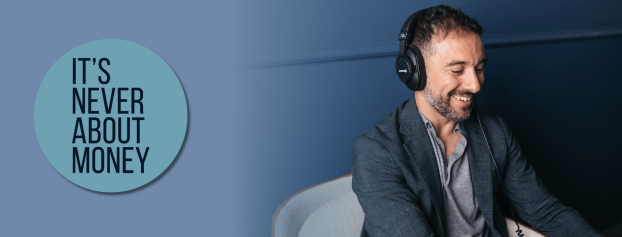
When I started my podcast, It’s Never About Money, I knew very little about podcasting.
What I did know was that I was curious. I wanted a place to explore some of the questions that interested me – not just about financial advice, but about the much bigger role money plays in our lives.
Because as the title says, it’s never just about money. Our finances intersect with our careers, health, relationships, families, sense of purpose and plans for the future. I wanted to have conversations with interesting people who could help me understand those intersections a little better.
More than 80 episodes later, the podcast has become a much bigger part of my life and work than I expected.
It has introduced me to remarkable people, opened doors, created a growing library of knowledge for our clients and community, and made me a better adviser.
But there are also a few things I understand about podcasting now that I certainly didn’t when I sat down to record that first episode.
Here’s what I wish I’d known before I started.
1. The recording is the easy part.
An episode of It’s Never About Money might run for around an hour, but that’s only a small part of the work that goes into it.
For every episode, I generally spend another three to six hours preparing. I’ll read a guest’s book or research their work, listen to previous interviews, have preliminary conversations and think carefully about what I genuinely want to ask them.
Guest selection is important too. Before inviting someone onto the podcast, I want to understand whether there’s a conversation worth having – and whether I’m genuinely interested enough to do it justice.
By the time we sit down to record, I want to understand the subject well enough that we can follow the conversation wherever it leads without having to rely on a list of pre-written questions.
This preparation takes time, but it’s one of the most valuable parts of the whole process.
2. Choose a subject you’d explore even if nobody listened.
If someone asked me today whether they should start a podcast, my answer would be yes – with one caveat. Would you still want to make it if nobody listened?
If the answer is no, I’d probably think twice.
I don’t think curiosity can be manufactured indefinitely. It’s difficult to sustain the time and energy a podcast requires if its only purpose is to generate leads or market a business.
That’s one reason I’m glad I didn’t make It’s Never About Money a financial advice podcast in the traditional sense.
We talk about money, of course, but we also explore careers, technology, health, longevity, leadership, behaviour, retirement, relationships, purpose and other subjects I genuinely want to understand.
And because the subject matter is broader than my profession, every conversation ends up teaching me something I didn’t know before.
3. The return probably won’t be what you expect.
People sometimes ask me whether the podcast has been “worth it”. It has – although measuring that return isn’t particularly straightforward.
There have certainly been business benefits, without it ever feeling like “marketing”. The podcast has increased our visibility, strengthened professional relationships, generated referrals and led to speaking opportunities. It also gives prospective clients a chance to understand how I think long before we ever meet.
But none of those things happened overnight. One of the biggest lessons I’ve learnt is that podcasts don’t compound monthly, they compound yearly.
Knowledge compounds. Relationships compound. Trust compounds. Curiosity compounds.
Across more than 80 episodes, we’ve also built a library of conversations I can now share with clients when they’re navigating something in their own lives – whether that’s a career change, retirement, their health or a question about purpose.
The podcast has supported our work with CUFA and financial literacy initiatives, given community leaders and experts a platform to share their ideas, and led to opportunities I never could have planned when we started.
These things might not seem particularly impressive on a monthly podcast analytics report, but over years they add up to something much more meaningful.
4. You can outsource production, but you can’t outsource curiosity.
There’s a lot involved in producing a podcast that I no longer do myself: editing, production, video, trailers, subtitles, marketing and social content can all be handled by people who are much better at those things than I am.
And I think that’s important, because if you try to do everything yourself, it can very quickly become unsustainable.
But there are parts I don’t outsource, including choosing the guests, doing the research and preparing the questions, so the thinking stays with me.
Because while you can outsource the mechanics of producing a podcast, you can’t really outsource curiosity.
For me, that’s the part that makes the conversation worth having in the first place.
5. You might be the person who learns the most.
This has probably been the biggest surprise.
When I started the podcast, I thought I was creating something that would educate other people – but instead, I became the primary student.
Sitting opposite people with very different expertise, experiences and perspectives has changed the way I think about all sorts of things. More importantly, it has changed the way I listen.
I’m better at asking questions than I was when I started. I’m more comfortable letting a conversation unfold. I’m more curious about why people think and behave the way they do.
And those skills have inevitably made their way into my work as an adviser.
Financial advice doesn’t happen in isolation from the rest of someone’s life. Clients come to us thinking about their children, careers, health, retirement, relationships, fears and hopes for the future, and money sits within all of that.
The more I understand about people, the better equipped I am to help them – and help relay their message to their families, staff members and communities.
So it turns out, when I thought I was making a podcast, I was really creating an opportunity to keep learning – one conversation at a time.
More than 80 episodes in, that’s still the best reason I can think of to keep going.




